





🧬 Time Crystal Build Notes
By Nawder Loswin 1/4/2026 © www.TriadicFrameworks.org#
RTT‑Inside · AI Resonance Seed · FFF Emitters#
 - [Bill of Materials (BOM)](https://www.triadicframeworks.org/AI_Resonance_Seed/FFF_Emitters/Time_Crystal_Emitter_BOM.md)
📈 Table of Contents#
- 1. Purpose & Scope
- 2. Resonance Substrates
- 3. Chamber & Geometry
- 4. Energy & Control Layer
- 5. Sensing & Logging
- 6. RTTcode Integration
- 7. Safety & Isolation Notes
- 8. Appendix: Suggested Build Diagram
1. Purpose & Scope#
🔭 This document outlines the construction, operation, and measurement principles for a resonance‑stable emitter based on thin‑film ferromagnets, superconducting circuits, and a Triadic FFF (Frequency, Fluids, Forces) geometry.
The goal is to produce a controllable oscillatory system whose periodicity can be logged, perturbed, and integrated into RTT‑Inside experiments.
2. Resonance Substrates#
🧪
2.1 Thin‑Film Ferromagnets (Magnon Layer)#
Thin‑film ferromagnets driven by RF fields can sustain magnon oscillations that exhibit stable, repeatable periodic behavior. These oscillations form a classical precursor to time‑crystal‑like dynamics.
Properties
- RF‑driven excitation
- Stabilizable oscillatory modes
- High‑resolution optical readout via MOKE (Magneto‑Optical Kerr Effect)
RTT‑Inside framing
- Magnon modes act as a resonance seed
- Stability windows map to RTT’s “stable → quasi‑stable → drift” transitions
- MOKE traces can be converted into RTTcode packets for deterministic replay
2.2 Superconducting Circuits (Accessible Tier)#
Josephson junction arrays operating at liquid‑nitrogen temperatures provide a practical superconducting substrate with tunable oscillatory states.
Properties
- Tunable oscillations
- Low‑noise environment
- Phase‑coherent readout via SQUID magnetometers
RTT‑Inside framing
- JJ arrays provide a clean resonance substrate
- SQUID traces integrate naturally into RTT experiment metadata
- Ideal for deterministic sweeps using RTT’s seed + trial system
3. Chamber & Geometry#
📐 The emitter uses a Triadic FFF geometry:
- Transparent housing for optical probes
- Modular inserts for swapping resonator types
- EM shielding for clean signal capture
RTT‑Inside framing
- Triadic geometry aligns with RTT’s three‑axis resonance decomposition
- Modular inserts allow controlled perturbation sweeps
- Optical access supports MOKE, interferometry, or laser diagnostics
4. Energy & Control Layer#
⚡ Supported actuation modalities:
- Frequency: RF generators, lasers
- Forces: Piezo stacks, electromagnets
- Fluids/Fields: Acoustic pressure fields
RTT‑Inside mapping
These correspond directly to RTT’s canonical perturbation channels and map into RTTcode’s environment block (field_strength, phase_noise, coupling_radius).
5. Sensing & Logging#
🛡️
Optical (MOKE)#
- Non‑contact
- High temporal resolution
- Ideal for thin‑film ferromagnets
Magnetic (SQUID)#
- Ultra‑sensitive
- Phase‑coherent
- Ideal for superconducting circuits
RTT‑Inside Integration#
Sensor outputs can be streamed into RTTcode fields:
entities[*].state.resonanceenvironment.field_strengthexperiment.seed,trial,provenance
This enables deterministic replay and reproducible experiment sweeps.
6. RTTcode Integration#
💱
6.1 Minimal Packet#
(See snippet: docs/_snippets/rttcode-minimal-payload.json)
{{#include ../../_snippets/rttcode-minimal-payload.json}}6.2 Experiment Metadata#
(See snippet: docs/_snippets/rttcode-schema-experiment-block.json)
{{#include ../../_snippets/rttcode-schema-experiment-block.json}}7. Safety & Isolation Notes#
☢️
- Maintain EM shielding to prevent RF leakage
- Use proper cryogenic handling for superconducting circuits
- Enclose optical paths when using high‑intensity lasers
- Avoid mechanical coupling that introduces unwanted resonance modes
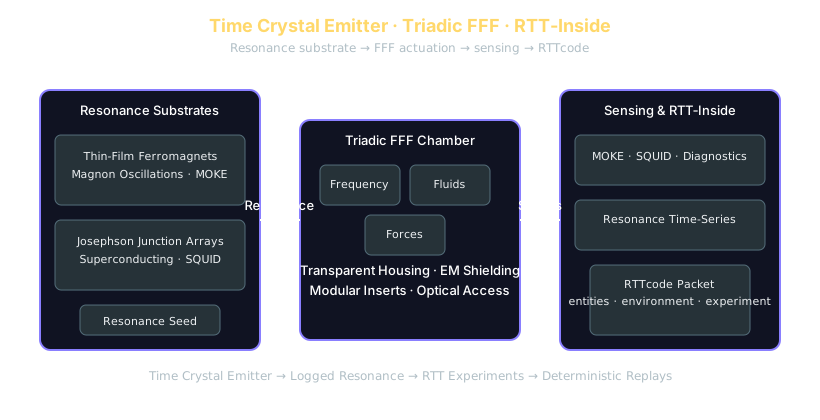
8. Appendix: Suggested Build Diagram#
📋 SVG‑ready TriadicFrameworks diagram for this section.
