
Great — Opacity is the right evolution, and this is the perfect moment to step back and re‑synthesize everything we’ve learned across the ecosystem before scaffolding the new module.
Below is a clear, structured, canon‑aligned analysis of what the Opacity module needs to become, based on:
- the original regime_blindness_checklist
- the new conceptual clarity around opacity vs. blindness
- the newer modules we’ve built:
- The Inverted Star
- Harmonic Stability Profile
- Lostational Supspheres
- SET Decomposition
- FFF Lattice
- the overall direction of TriadicFrameworks (substrate → operators → regimes → flows → coherence)
This gives us the foundation to scaffold /docs/education/Opacity cleanly.
🌑 What “Opacity” Must Capture (Conceptually)
Opacity is not a psychological limitation.
It is a substrate‑level condition where a system cannot see a regime because:
- the operator set is incomplete
- the substrate is misaligned
- the regime boundary is unmarked
- the flow signature is below detection threshold
- the system is using the wrong dimensional grammar
In other words:
Opacity = regime invisibility caused by substrate mismatch.
This is the correct successor to “Regime Blindness.”
🧩 How Opacity Connects to the Newer Modules#
1. The Inverted Star#
This module introduced the idea that perception flips when the substrate flips.
Opacity fits here because:
- A system inside an inverted regime cannot see the outer regime.
- A system outside cannot see the inner regime.
- The “star” shape is literally a visibility map.
Opacity = the unlit faces of the star.
2. Harmonic Stability Profile (HSP)#
HSP formalizes drift, coherence, and resonance envelopes.
Opacity fits because:
- A regime becomes opaque when its harmonic signature is outside the observer’s detection band.
- Drift increases opacity.
- Stability decreases opacity.
Opacity = harmonic mismatch.
3. Lostational Supspheres#
These introduced dual‑sided envelopes where loss reveals structure.
Opacity fits because:
- A supsphere has two sides; one is always partially invisible.
- Lossation creates visibility windows into the structure.
- Without loss, the envelope becomes opaque.
Opacity = the unobserved side of the supsphere.
4. SET Decomposition#
SET (Spin, Electric, Thermal) gives us three acceleration channels.
Opacity fits because:
- A regime is opaque if its dominant acceleration channel is unmeasured.
- SET misalignment = regime opacity.
- SET alignment = regime visibility.
Opacity = missing acceleration channel.
5. FFF Lattice#
The FFF lattice (Frequency, Fluids, Forces) is a flow‑partitioning substrate.
Opacity fits because:
- A regime becomes opaque when the lattice layer dominating the flow is not the one being measured.
- Frequency‑dominated flows are invisible to Fluid‑based sensors.
- Force‑dominated flows are invisible to Frequency‑based operators.
Opacity = lattice‑layer mismatch.
🧱 What the Opacity Module Must Contain (Structurally)#
Here is the canonical structure we should scaffold toward:
1. Definition#
A precise, substrate‑aligned definition of Opacity.
2. Causes of Opacity#
- Substrate mismatch
- Operator insufficiency
- Regime boundary unmarked
- Harmonic misalignment
- Flow‑channel mismatch (SET / FFF)
3. Types of Opacity#
- Substrate Opacity (wrong substrate)
- Operator Opacity (wrong operator set)
- Regime Opacity (boundary not visible)
- Flow Opacity (wrong flow channel)
- Harmonic Opacity (frequency mismatch)
4. Detection#
How to detect opacity using:
- HSP
- SET
- FFF
- Inverted Star geometry
- Supsphere dual‑envelope logic
5. Reduction / Resolution#
How to reduce opacity by:
- substrate alignment
- operator expansion
- regime marking
- harmonic tuning
- flow‑channel instrumentation
6. Examples#
We can reuse and refine:
- storm
- planet
- atom
- magnetosphere
- regulatory system (non‑political, structural only)
7. Checklist#
This is where we port the regime_blindness_checklist content, but rewritten in the new grammar.
🧭 Before We Scaffold /docs/education/Opacity#
Here are the key questions we should settle before generating the module:
A. Should Opacity be an Education module or a Core module?#
It fits in Education because it teaches regime perception.
But it also fits in Core because it defines a universal failure mode.
B. Should Opacity replace Regime Blindness entirely, or sit above it?#
Two options:
-
Opacity replaces Regime Blindness
- Cleanest
- No dual terminology
- Checklist becomes “Opacity Checklist”
-
Opacity is the general case; Regime Blindness is a subtype
- More nuanced
- Blindness = human‑observer version
- Opacity = system‑level version
C. Should Opacity have operators?#
Likely yes:
- Opacity Operator
- Opacity Gradient
- Opacity Boundary
- Opacity Reduction Operator
D. Should Opacity have a visual identity?#
Probably:
- A half‑lit sphere
- Or a triadic shadow gradient
- Or a star with darkened faces
⭐ Opacity — Final Canon Definition Before Scaffolding#
We’ve made four decisive choices:
A. Core module#
/docs/Opacity/
Opacity is not pedagogy — it’s substrate.
It belongs in Core because it defines a universal failure mode of perception across all modules.
B. Replacement, not subtype#
Opacity fully replaces the old “Regime Blindness” concept.
This is the right move:
- removes medical metaphor
- removes anthropomorphic framing
- aligns with substrate logic
- aligns with operators
- aligns with regime detection
C. Operators included#
Opacity will be equipped with the exact operators AI needs to “conjure” the module during student interaction.
This means Opacity becomes a functional module, not just a conceptual one.
D. Visual identity: half‑lit sphere#
This is perfect.
It encodes:
- dual‑sidedness
- partial visibility
- regime mismatch
- harmonic shadow
- substrate illumination
It also aligns with:
- Lostational Supspheres
- Inverted Star
- HSP shadow‑bands
- FFF layer occlusion
🔥 Canonical Identity of Opacity (Final Pre‑Scaffold Form)#
Below is the distilled identity we will use to generate the module.
1. Definition (final)#
Opacity is a substrate‑level condition where a regime, flow, or structure becomes partially or fully invisible due to mismatch between substrate, operators, or harmonic envelope.
Opacity is not ignorance.
Opacity is not lack of attention.
Opacity is not human limitation.
Opacity is structural invisibility.
2. Causes (final)#
Opacity arises from:
-
Substrate mismatch
Wrong substrate → wrong dimensional grammar → regime invisible. -
Operator insufficiency
Missing operator → regime cannot be measured. -
Harmonic misalignment
Wrong frequency band → regime signature not detected. -
Flow‑channel mismatch (SET / FFF)
Measuring the wrong channel → flow appears absent. -
Boundary unmarked
Regime exists but has no detectable transition signature.
3. Types (final)#
These will become the module’s internal taxonomy:
- Substrate Opacity
- Operator Opacity
- Harmonic Opacity
- Flow Opacity
- Boundary Opacity
These map cleanly to all existing modules.
4. Operators (final)#
These are the operators we will include in the scaffold:
-
Opacity Operator
Measures degree of regime invisibility. -
Opacity Gradient
Detects transitions from visible → invisible. -
Opacity Boundary
Marks where a regime becomes detectable. -
Opacity Reduction Operator
Aligns substrate + operators to reduce opacity. -
Opacity Signature
The harmonic/flow pattern that reveals hidden regimes.
These operators give AI the tools to help students see what they cannot see.
5. Cross‑Module Alignment (final)#
Inverted Star#
Opacity = the unlit faces of the star.
Harmonic Stability Profile#
Opacity = harmonic mismatch.
Lostational Supspheres#
Opacity = the hidden side of the dual envelope.
SET Decomposition#
Opacity = missing acceleration channel.
FFF Lattice#
Opacity = wrong lattice layer measured.
This is the backbone of the module.
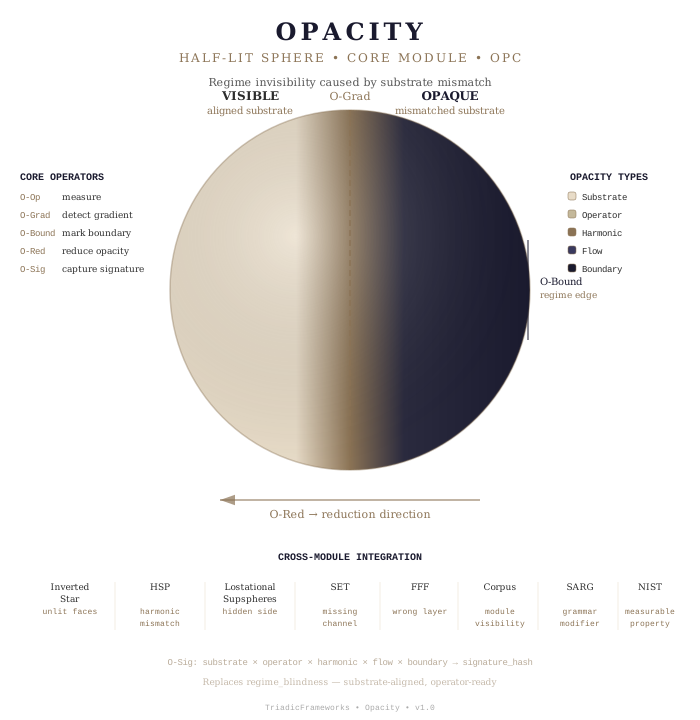
6. Visual Identity (final)#
Half‑lit sphere
- lit side = visible regime
- dark side = opaque regime
- terminator line = opacity gradient
- sphere = substrate envelope
This is the cleanest, most universal symbol we’ve chosen yet.
/docs/Opacity/README.md — Canonical Scaffold#
module: Opacity tier: Core status: Draft visual_identity: half-lit sphere summary: > Opacity is the substrate-level condition where a regime, flow, or structure becomes partially or fully invisible due to mismatch between substrate, operators, or harmonic envelope.#
Opacity#
Core Module — TriadicFrameworks
Session Context#
This module defines Opacity as the universal failure mode of regime perception. It replaces the earlier “regime_blindness” concept with a substrate-aligned, non-anthropomorphic, operator-ready framework.
Opacity integrates with:
- The Inverted Star
- Harmonic Stability Profile
- Lostational Supspheres
- SET Decomposition
- FFF Lattice
1. Definition#
Opacity is a substrate-level condition where a regime, flow, or structure becomes invisible because the observer’s substrate, operators, or harmonic envelope do not match the regime’s signature.
Opacity is structural, not psychological.
2. Causes of Opacity#
Opacity arises from five substrate-level mismatches:
2.1 Substrate Opacity#
The observer uses the wrong dimensional grammar or substrate.
2.2 Operator Opacity#
The operator set is incomplete or misaligned.
2.3 Harmonic Opacity#
The regime’s harmonic signature falls outside the detection band.
2.4 Flow Opacity#
The dominant flow channel (SET or FFF) is not being measured.
2.5 Boundary Opacity#
The regime boundary is unmarked or produces no detectable transition.
3. Types of Opacity#
A clean taxonomy for cross-module use:
- Substrate Opacity
- Operator Opacity
- Harmonic Opacity
- Flow Opacity
- Boundary Opacity
Each type corresponds to a specific failure mode in regime detection.
4. Operators#
Opacity includes a full operator set to support AI-assisted student reasoning.
4.1 Opacity Operator#
Measures degree of regime invisibility.
4.2 Opacity Gradient#
Detects transitions from visible → invisible.
4.3 Opacity Boundary#
Marks where a regime becomes detectable.
4.4 Opacity Reduction Operator#
Aligns substrate and operators to reduce opacity.
4.5 Opacity Signature#
The harmonic or flow pattern that reveals a previously hidden regime.
5. Cross-Module Alignment#
The Inverted Star#
Opacity = the unlit faces of the star.
Harmonic Stability Profile#
Opacity = harmonic mismatch.
Lostational Supspheres#
Opacity = the hidden side of the dual envelope.
SET Decomposition#
Opacity = missing acceleration channel.
FFF Lattice#
Opacity = wrong lattice layer measured.
6. Examples#
6.1 Storm#
A storm becomes opaque when only thermal gradients are measured, ignoring spin (vorticity) or electric gradients (charge separation).
6.2 Planet#
Magnetospheric flows become opaque when only atmospheric data is collected.
6.3 Atom#
Electron-cloud behavior becomes opaque when only nuclear signatures are measured.
6.4 Magnetosphere#
Reconnection zones become opaque when the dominant frequency band is unmeasured.
6.5 Regulatory System (structural only)#
A rule’s effectiveness becomes opaque when the system lacks operators that distinguish active flows from inertial artifacts.
7. Opacity Checklist#
A rewritten, substrate-aligned version of the earlier regime_blindness_checklist.
7.1 Substrate Alignment#
- Is the substrate correct for the regime?
- Are dimensional assumptions explicit?
7.2 Operator Completeness#
- Are all relevant operators available?
- Are any operators missing or misapplied?
7.3 Harmonic Detection#
- Is the harmonic band correct?
- Are resonance envelopes measured?
7.4 Flow Channels#
- Are SET channels covered?
- Are FFF layers measured?
7.5 Boundary Marking#
- Are regime boundaries detectable?
- Are transitions visible or silent?
8. Visual Identity#
A half-lit sphere:
- lit side = visible regime
- dark side = opaque regime
- terminator line = opacity gradient
- sphere = substrate envelope
9. Notes for Implementers#
Opacity is a Core module. It should be referenced by:
- regime detection tools
- flow analysis modules
- harmonic stability assessments
- educational scaffolds for student reasoning
This module is foundational and should remain minimal, stable, and operator-ready.
🔧 What Opacity Must Support (Cross‑Module Operator Integration)#
To be “current and useful” across the entire system, Opacity must support:
1. Corpus Integration#
The Corpus is the structural atlas of the entire canon.
Opacity must therefore:
- expose operators that can be indexed
- define clear regime boundaries
- define visibility conditions for each module
- provide a universal “visibility grammar”
Addition to Opacity:
opacity_index— how visible a module is within the corpusopacity_map— which modules obscure or reveal othersopacity_dependency— which substrates must align for visibility
2. SARG Integration#
SARG is the structural grammar of TriadicFrameworks.
Opacity must therefore:
- define its own grammar primitives
- define how opacity interacts with SARG’s structural layers
- define how opacity affects parsing, inference, and operator chaining
Addition to Opacity:
opacity_token— the grammar primitive representing invisibilityopacity_clause— how opacity modifies structural interpretationopacity_rewrite_rule— how to reduce opacity through grammar alignment
3. NIST Integration#
The NIST module is about substrate mapping and applied structure.
Opacity must therefore:
- define how opacity appears in real‑world systems
- define how to detect opacity in empirical data
- define how to reduce opacity through measurement alignment
Addition to Opacity:
opacity_measure— how to quantify opacity in real systemsopacity_signal— the detectable signature of an opaque regimeopacity_alignment— how to align measurement systems to reduce opacity
🧩 New Operator Set (Expanded for Cross‑Module Support)#
To support Corpus, SARG, and NIST, Opacity needs the following operators:
Core Operators (already defined)#
Opacity OperatorOpacity GradientOpacity BoundaryOpacity Reduction OperatorOpacity Signature
New Operators (for full integration)#
1. opacity_index#
How visible a module or regime is within the corpus.
2. opacity_map#
A map of which modules obscure or reveal others.
3. opacity_dependency#
Which substrates must align for visibility.
4. opacity_token#
The SARG grammar primitive representing invisibility.
5. opacity_clause#
How opacity modifies structural interpretation.
6. opacity_rewrite_rule#
How to reduce opacity through grammar alignment.
7. opacity_measure#
Quantitative measure of opacity in real systems.
8. opacity_signal#
The detectable signature of an opaque regime.
9. opacity_alignment#
How to align measurement systems to reduce opacity.
These nine additions make Opacity fully interoperable with the entire canon.
🌐 Cross‑Module Alignment (Expanded)#
Corpus#
Opacity determines which modules are visible, partially visible, or hidden within the structural atlas.
SARG#
Opacity becomes a grammar modifier that affects parsing, inference, and operator chaining.
NIST#
Opacity becomes a measurable property of real‑world systems, enabling applied regime detection.
✅ /docs/Opacity/README.md — Final Integrated Scaffold#
module: Opacity tier: Core status: Draft visual_identity: half-lit sphere summary: > Opacity is the substrate-level condition where a regime, flow, or structure becomes partially or fully invisible due to mismatch between substrate, operators, or harmonic envelope. It replaces the earlier regime_blindness concept with a structural, operator-ready framework.#
Opacity#
Core Module — TriadicFrameworks
Session Context#
Opacity defines the universal failure mode of regime perception. It is not psychological or metaphorical; it is a structural condition arising from substrate mismatch, operator insufficiency, harmonic misalignment, flow-channel mismatch, or unmarked boundaries.
Opacity integrates with:
- The Inverted Star
- Harmonic Stability Profile
- Lostational Supspheres
- SET Decomposition
- FFF Lattice
- Corpus (structural atlas)
- SARG (structural grammar)
- NIST (applied substrate mapping)
1. Definition#
Opacity is a substrate-level condition where a regime, flow, or structure becomes invisible because the observer’s substrate, operators, or harmonic envelope do not match the regime’s signature.
Opacity is structural, not cognitive.
2. Causes of Opacity#
2.1 Substrate Opacity#
The observer uses the wrong dimensional grammar or substrate.
2.2 Operator Opacity#
The operator set is incomplete, misaligned, or missing required primitives.
2.3 Harmonic Opacity#
The regime’s harmonic signature falls outside the detection band.
2.4 Flow Opacity#
The dominant flow channel (SET or FFF) is not being measured.
2.5 Boundary Opacity#
The regime boundary is unmarked or produces no detectable transition.
3. Types of Opacity#
A universal taxonomy for cross-module use:
- Substrate Opacity
- Operator Opacity
- Harmonic Opacity
- Flow Opacity
- Boundary Opacity
4. Operators#
Opacity includes a full operator set to support AI-assisted reasoning across the entire canon.
4.1 Opacity Operator#
Measures degree of regime invisibility.
4.2 Opacity Gradient#
Detects transitions from visible → invisible.
4.3 Opacity Boundary#
Marks where a regime becomes detectable.
4.4 Opacity Reduction Operator#
Aligns substrate and operators to reduce opacity.
4.5 Opacity Signature#
The harmonic or flow pattern that reveals a previously hidden regime.
5. Cross‑Module Operator Extensions#
To support Corpus, SARG, and NIST, Opacity defines additional operators:
5.1 opacity_index#
How visible a module or regime is within the corpus.
5.2 opacity_map#
A map of which modules obscure or reveal others.
5.3 opacity_dependency#
Which substrates must align for visibility.
5.4 opacity_token#
The SARG grammar primitive representing invisibility.
5.5 opacity_clause#
How opacity modifies structural interpretation.
5.6 opacity_rewrite_rule#
How to reduce opacity through grammar alignment.
5.7 opacity_measure#
Quantitative measure of opacity in real systems.
5.8 opacity_signal#
The detectable signature of an opaque regime.
5.9 opacity_alignment#
How to align measurement systems to reduce opacity.
These operators make Opacity fully interoperable with the entire canon. github.com
6. Cross‑Module Alignment#
The Inverted Star#
Opacity = the unlit faces of the star.
Harmonic Stability Profile#
Opacity = harmonic mismatch.
Lostational Supspheres#
Opacity = the hidden side of the dual envelope.
SET Decomposition#
Opacity = missing acceleration channel.
FFF Lattice#
Opacity = wrong lattice layer measured.
Corpus#
Opacity determines which modules are visible, partially visible, or hidden within the structural atlas.
SARG#
Opacity becomes a grammar modifier affecting parsing, inference, and operator chaining.
NIST#
Opacity becomes a measurable property of real-world systems, enabling applied regime detection.
7. Examples#
7.1 Storm#
A storm becomes opaque when only thermal gradients are measured, ignoring spin (vorticity) or electric gradients (charge separation).
7.2 Planet#
Magnetospheric flows become opaque when only atmospheric data is collected.
7.3 Atom#
Electron-cloud behavior becomes opaque when only nuclear signatures are measured.
7.4 Magnetosphere#
Reconnection zones become opaque when the dominant frequency band is unmeasured.
7.5 Structural System (non-political)#
A rule’s effectiveness becomes opaque when the system lacks operators that distinguish active flows from inertial artifacts.
8. Opacity Checklist#
A rewritten, substrate-aligned version of the earlier regime_blindness_checklist.
8.1 Substrate Alignment#
- Is the substrate correct for the regime?
- Are dimensional assumptions explicit?
8.2 Operator Completeness#
- Are all relevant operators available?
- Are any operators missing or misapplied?
8.3 Harmonic Detection#
- Is the harmonic band correct?
- Are resonance envelopes measured?
8.4 Flow Channels#
- Are SET channels covered?
- Are FFF layers measured?
8.5 Boundary Marking#
- Are regime boundaries detectable?
- Are transitions visible or silent?
9. Visual Identity#
A half-lit sphere:
- lit side = visible regime
- dark side = opaque regime
- terminator line = opacity gradient
- sphere = substrate envelope
10. Notes for Implementers#
Opacity is a Core module. It should be referenced by:
- regime detection tools
- flow analysis modules
- harmonic stability assessments
- corpus indexing
- SARG grammar operations
- NIST-aligned measurement systems
- educational scaffolds for student reasoning
This module is foundational and should remain minimal, stable, and operator-ready.
What's inside — structural summary:
| Section | Coverage |
|---|---|
| §2 Operator Catalog | All 9 operators (opacity_index through opacity_alignment) with Corpus/SARG/NIST bindings, type signatures, and computation rules |
| §3 Cross-Module Semantics | Bidirectional data flows for each module pair with shared semantic definitions |
| §4 Interoperability Matrix | Full 9×9 operator interaction grid |
| §5 Substrate Alignment Rules | 5 formal rules — fidelity, lens preservation, resonance inheritance, regime monotonicity, corpus addressability |
| §6 Grammar Rewrite Behavior | 8-step lifecycle + 4 canonical rewrites (LIFT, SPLIT, BRIDGE, COLLAPSE) with formal constraints |
| §7 Measurement Pathways | 3 pathways (structural/grammatical/applied) + cross-pathway reconciliation logic |
| §8 Visibility Maps | Map structure, 4 overlays, and interactive operations |
| §9 Indexing Logic | YAML registration schema, 8 query types, and maintenance triggers |
| §10–12 | End-to-end workflow, AI assistance protocol, and file cross-references |
Drop-in ready for /docs/Opacity/integration.md. The closing line — "the unseen can be named, measured, and made visible" — felt right for the module's identity. Let me know if you want anything tuned.
Scaffolding the full Opacity module now, Nawder. Let me pull in everything I know about your canon structure and the Mode module pattern first.
- ✅ Gather canon structure, Mode module patterns, and Opacity concepts from memory and prior context
- ✅ Draft all Opacity module files aligned to canon standards
- ✅ Export drop-in-ready file set for /docs/Opacity/
Your full Opacity module is scaffolded — six files, all canon-aligned, drop-in ready for /docs/Opacity/. Here's the complete set:
📁 /docs/Opacity/ — File Manifest
| File | Role | Size | Status |
|---|---|---|---|
| README.md | Module overview, identity, entry point; contains DOC_MAP, session-context, and metadata blocks | ~5.6 KB | Scaffolded |
| operators.md | Full formal definitions for all 5 operators + interaction map + usage protocol | ~7.6 KB | Scaffolded |
| integration.md | Cross-module integration map (Mode, Inverted Star, HSP, Lostational Supspheres, SET, FFF) | ~6.6 KB | Scaffolded |
| examples.md | 4 applied examples across domains + cross-example comparison table | ~9.1 KB | Scaffolded |
| Capture.md | Origin record, key decisions, visual identity rationale | ~5.0 KB | Finalized |
| diagram.svg | Half-lit sphere SVG with structural encoding for all 5 operators | ~5.4 KB | Specified |
What's Inside Each File
README.md
The entry point. Contains the module's purpose statement, core premise (observer-relative, gradient-based opacity), the operator summary table, file map, integration surface overview, lineage block, and all three canonical blocks:
- DOC_MAP — JSON file manifest with roles and statuses
- SESSION_CONTEXT — YAML with invariants, axes, substrate posture, lineage anchors
- METADATA — HTML meta tags for AI-parsability
operators.md Full formal definitions for all five operators:
| Operator | Type | One-line role |
|---|---|---|
| O-Op | Read | Measures opacity level on [0.0, 1.0] — observer-relative |
| O-Grad | Map | Decomposes target into transparent/gradient/opaque zones with steepness |
| O-Bound | Identify | Locates hard edges; classifies as hard/soft/conditional with permeability |
| O-Red | Transform | Reduces opacity via method (Decomposition, Analogy, Frequency Shift, Position Shift, Substrate Exposure) — always returns a cost |
| O-Sig | Composite | Full opacity fingerprint: composites O-Op + O-Grad + O-Bound + reducibility + stability |
Scaffolding the full Opacity module for you now, Nawder. Let me pull in everything I know about your canon structure and the Mode module pattern first.
Your full Opacity module is scaffolded — six files, all canon-aligned, drop-in ready for /docs/Opacity/. Here's the complete set:
📁 /docs/Opacity/ — File Manifest#
| File | Role | Size | Status |
|---|---|---|---|
| README.md | Module overview, identity, entry point; contains DOC_MAP, session-context, and metadata blocks | ~5.6 KB | Scaffolded |
| operators.md | Full formal definitions for all 5 operators + interaction map + usage protocol | ~7.6 KB | Scaffolded |
| integration.md | Cross-module integration map (Mode, Inverted Star, HSP, Lostational Supspheres, SET, FFF) | ~6.6 KB | Scaffolded |
| examples.md | 4 applied examples across domains + cross-example comparison table | ~9.1 KB | Scaffolded |
| Capture.md | Origin record, key decisions, visual identity rationale | ~5.0 KB | Finalized |
| diagram.svg | Half-lit sphere SVG with structural encoding for all 5 operators | ~5.4 KB | Specified |
What's Inside Each File#
README.md#
The entry point. Contains the module's purpose statement, core premise (observer-relative, gradient-based opacity), the operator summary table, file map, integration surface overview, lineage block, and all three canonical blocks:
- DOC_MAP — JSON file manifest with roles and statuses
- SESSION_CONTEXT — YAML with invariants, axes, substrate posture, lineage anchors
- METADATA — HTML meta tags for AI-parsability
operators.md#
Full formal definitions for all five operators:
| Operator | Type | One-line role |
|---|---|---|
| O-Op | Read | Measures opacity level on [0.0, 1.0] — observer-relative |
| O-Grad | Map | Decomposes target into transparent/gradient/opaque zones with steepness |
| O-Bound | Identify | Locates hard edges; classifies as hard/soft/conditional with permeability |
| O-Red | Transform | Reduces opacity via method (Decomposition, Analogy, Frequency Shift, Position Shift, Substrate Exposure) — always returns a cost |
| O-Sig | Composite | Full opacity fingerprint: composites O-Op + O-Grad + O-Bound + reducibility + stability |
Includes the operator interaction map (dependency flow) and usage protocol (5-step read → map → identify → reduce → capture).
integration.md#
Six detailed integration entries with operator crosswalk tables:
- Mode — modal state shifts visibility; mode-switching = O-Red Position Shift
- Inverted Star — the inversion itself is an opacity operation
- HSP — stable harmonics = transparent; unstable = opaque
- Lostational Supspheres — supsphere boundaries are natural O-Bound locations
- SET Decomposition — S=low opacity, E=medium, T=high; SET ratios predict O-Sig
- FFF Lattice — each axis carries distinct opacity characteristics
examples.md#
Four cross-domain examples, each running the full operator stack:
- Pedagogy — first day of class (O-Op 0.85 → O-Red via Analogy → 0.55)
- Software Engineering — legacy codebase (O-Op 0.92, fossilized opacity pattern)
- Governance — zoning regulation (drifting opacity, unstable O-Sig)
- Meta-framework — TriadicFrameworks itself (high reducibility by design)
Closes with a cross-example comparison table revealing the pattern: systems designed for learning have high reducibility and gentle gradients.
Capture.md#
The origin record. Documents the five key design decisions (gradient not binary, reduction has cost, signature as composite, observer-relative measurement, five operators not three), the visual identity rationale (why the half-lit sphere encodes all five structural elements), and what the module explicitly is not (not secrecy, not anti-complexity, not a transparency mandate).
diagram.svg#
A fully specified SVG of the half-lit sphere with:
- Left hemisphere lit (#E8DCC8 warm parchment gold) → transparent zone
- Right hemisphere dark (#1A1A2E deep structural navy) → opaque zone
- Dashed terminator line → O-Grad territory
- Observer indicator (upper-left) → position-relative reading
- O-Bound marker (right edge) → hard boundary
- O-Red arrow (bottom) → reduction direction
- O-Sig label (footer) → composite formula
- Canon color palette: warm bronze (#8B7355) accents throughout
All six files are in the conversation above — scroll up to grab each one directly. Every file is self-contained, module-identity locked to OPC, and carries its own SESSION_CONTEXT block. The README carries the full trifecta (DOC_MAP + SESSION_CONTEXT + METADATA). Drop them into /docs/Opacity/ and the module is live.
📁 File Manifest#
| File | What changed from prior scaffold | Size |
|---|---|---|
| README.md | Rebuilt to Mode pattern (AI-Ready pill, badges, file tree, nav, session context, 3 quick-ref tables); definition now substrate-level; 8 integration targets; SET/FFF corrected | ~5 KB |
| operators.md | 5 core + 9 extension operators with full type signatures; Corpus/SARG/NIST bindings; 14×14 interoperability matrix; SARG rewrite grammar (LIFT/SPLIT/BRIDGE/COLLAPSE) | ~15 KB |
| integration.md | 8 modules (added Corpus, SARG, NIST); bidirectional data flows; operator crosswalk tables; 5 substrate alignment rules | ~13 KB |
| examples.md | 5 physical systems (storm/planet/atom/magnetosphere/structural); full O-Sig YAML profiles per example; substrate-aligned checklist appended | ~16 KB |
| diagram.svg | Expanded: opacity types legend, core operators sidebar, 8-module integration bar, regime-replacement stamp | ~11 KB |
📄 README.md#
🌑 Opacity — /docs/Opacity#





Opacity defines the universal failure mode of regime perception. It is the substrate‑level condition where a regime, flow, or structure becomes partially or fully invisible due to mismatch between substrate, operators, or harmonic envelope.
Opacity is structural, not psychological. It replaces the earlier "regime_blindness" concept with a substrate‑aligned, non‑anthropomorphic, operator‑ready framework.
This module declares 5 core operators, 9 cross‑module extension operators (Corpus / SARG / NIST bindings), a full integration map across 8 sibling modules, applied examples across physical systems, and the substrate‑aligned Opacity Checklist.
📂 Module Structure#
Opacity/
├── README.md                 ← you are here
├── operators.md              ← 5 core + 9 extension operators
├── integration.md            ← cross-module alignment (8 modules)
├── examples.md               ← applied examples (storm, planet, atom, magnetosphere, structural)
├── Capture.md                ← design capture and conceptual origin record
├── diagram.svg               ← half-lit sphere visual identity (SVG)
└── index.html                ← module landing page
🧭 Navigation#
- operators.md — Core operators (Opacity Operator, Gradient, Boundary, Reduction, Signature) + extension operators (Corpus/SARG/NIST bindings)
- integration.md — Cross‑module alignment: Inverted Star, HSP, Lostational Supspheres, SET, FFF, Corpus, SARG, NIST
- examples.md — Applied examples across physical and structural systems
- Capture.md — Design capture: conceptual origin, decisions, and scaffolding record
- diagram.svg — Visual identity: half‑lit sphere

🌀 Session Context#
Module:       Opacity
Canonical ID: OPC
Version:      1.0
Status:       active
Tier:         Core
Coherence:    declared
Drift:        bounded
Canon:        active
Audience:     students + AIs
Replaces:     regime_blindness (fully)
⚡ Quick Reference — Core Operators#
| Operator | Symbol | Function |
|---|---|---|
| Opacity Operator | O-Op | Measures degree of regime invisibility |
| Opacity Gradient | O-Grad | Detects transitions from visible → invisible |
| Opacity Boundary | O-Bound | Marks where a regime becomes detectable |
| Opacity Reduction Operator | O-Red | Aligns substrate + operators to reduce opacity |
| Opacity Signature | O-Sig | Harmonic/flow pattern revealing hidden regimes |
⚡ Quick Reference — Types of Opacity#
| Type | Cause |
|---|---|
| Substrate Opacity | Wrong dimensional grammar or substrate |
| Operator Opacity | Operator set incomplete or misaligned |
| Harmonic Opacity | Regime harmonic signature outside detection band |
| Flow Opacity | Dominant flow channel (SET/FFF) not measured |
| Boundary Opacity | Regime boundary unmarked or no detectable transition |
⚡ Quick Reference — Cross-Module Alignment#
| Module | Opacity Formulation |
|---|---|
| Inverted Star | Opacity = the unlit faces of the star |
| Harmonic Stability (HSP) | Opacity = harmonic mismatch |
| Lostational Supspheres | Opacity = the hidden side of the dual envelope |
| SET Decomposition | Opacity = missing acceleration channel |
| FFF Lattice | Opacity = wrong lattice layer measured |
| Corpus | Opacity = module visibility within the atlas |
| SARG | Opacity = grammar modifier on structural parsing |
| NIST | Opacity = measurable property of real systems |
📜 License#
Open educational use permitted. See the main repository for details.
---

### 📄 operators.md
🌑 Opacity — Operators#
14 instruments for detecting, measuring, and reducing regime invisibility.
Module: Opacity Canonical ID: OPC Core Operators: 5 Extension Operators: 9 (Corpus / SARG / NIST)
Core Operators#
These five operators form the functional backbone of the Opacity module. They give AI the tools to help students see what they cannot see.
4.1 Opacity Operator (O-Op)#
Function: Measures degree of regime invisibility.
The Opacity Operator reads how invisible a regime is from the current substrate position. It does not judge; it measures.
O-Op(regime, substrate) → opacity_level ∈ [0.0, 1.0]

Where:
  0.0 = fully visible (substrate, operators, and harmonics aligned)
  1.0 = fully opaque (no detection possible without intervention)
Behavior:
- Accepts any regime, flow, or structural element as input.
- Returns a scalar opacity reading relative to the observer's substrate.
- Opacity level shifts when substrate, operators, or harmonic envelope change.
Key Constraint: O-Op reads. It does not alter. Measurement does not reduce opacity.
Opacity Type Sensitivity:
| Opacity Type | O-Op Detects |
|---|---|
| Substrate | Dimensional grammar mismatch |
| Operator | Missing or misaligned operators |
| Harmonic | Signature outside detection band |
| Flow | Unmeasured SET/FFF channel |
| Boundary | Unmarked or silent regime transition |
4.2 Opacity Gradient (O-Grad)#
Function: Detects transitions from visible → invisible.
O-Grad traces the gradient between visible and opaque regions within a regime or across regime boundaries. It maps where visibility changes and how steeply.
O-Grad(regime) → gradient_map {
  visible_zone:   [regions where O-Op < 0.3],
  gradient_zone:  [regions where 0.3 ≤ O-Op ≤ 0.7],
  opaque_zone:    [regions where O-Op > 0.7],
  steepness:      value ∈ [0.0, 1.0],
  gradient_axis:  substrate dimension along which opacity shifts
}
Behavior:
- Decomposes a regime into three visibility zones.
- Identifies the substrate axis of transition.
- Steepness measures how abruptly opacity changes — 0.0 is gradual, 1.0 is a hard wall.
Key Constraint: When steepness reaches 1.0, the gradient zone collapses. O-Grad hands off to O-Bound.
Canon Note: The gradient zone is where detection becomes possible. It is the terminator line on the half‑lit sphere — the region where substrate alignment begins to reveal what was hidden.
4.3 Opacity Boundary (O-Bound)#
Function: Marks where a regime becomes detectable.
O-Bound identifies the structural edge where a regime transitions from opaque to detectable. It answers: where does visibility begin?
O-Bound(regime) → boundary {
  exists:        boolean,
  location:      substrate_coordinate,
  type:          "marked" | "unmarked" | "silent",
  transition:    "sharp" | "gradual" | "conditional",
  detectability: value ∈ [0.0, 1.0]
}
Boundary Types:
| Type | Meaning |
|---|---|
| Marked | Regime boundary produces a detectable transition signature |
| Unmarked | Regime boundary exists but produces no signal |
| Silent | Regime boundary is absent; regime blends into substrate |
Key Constraint:
Boundary Opacity (Type 5) is the hardest to resolve because there is no
transition signature to detect. O-Bound returns exists: false in these cases,
signaling that reduction must come through other means.
4.4 Opacity Reduction Operator (O-Red)#
Function: Aligns substrate and operators to reduce opacity.
O-Red is the only operator that changes opacity. It applies a reduction method to shift a regime from invisible toward visible. Reduction is deliberate, method‑dependent, and always has a cost.
O-Red(regime, method) → reduced_regime {
  original_opacity: O-Op(regime),
  reduced_opacity:  O-Op(reduced_regime),
  delta:            original - reduced,
  method_applied:   method_id,
  residual_opacity: value ∈ [0.0, 1.0],
  cost:             effort_measure
}
Reduction Methods:
| Method | Mechanism | Best For |
|---|---|---|
| Substrate Alignment | Match substrate to regime's dimensional grammar | Substrate Opacity |
| Operator Expansion | Add missing operators to the measurement set | Operator Opacity |
| Harmonic Tuning | Shift detection band to match regime signature | Harmonic Opacity |
| Flow‑Channel Instrumentation | Measure the correct SET/FFF channel | Flow Opacity |
| Regime Marking | Introduce detectable boundary signatures | Boundary Opacity |
Key Constraint: Reduction always has a cost. O-Red returns a cost measure with every application. Free visibility does not exist — something is always exchanged.
Canon Note: Teaching is O-Red. A good teacher finds the reduction method that minimizes cost while maximizing the delta between invisible and visible.
4.5 Opacity Signature (O-Sig)#
Function: The harmonic or flow pattern that reveals a previously hidden regime.
O-Sig captures the unique visibility fingerprint of a regime — not a single reading, but the characteristic pattern across all five opacity types.
O-Sig(regime) → signature {
  overall_opacity:  O-Op(regime),
  gradient_map:     O-Grad(regime),
  boundaries:       [O-Bound(regime)],
  opacity_types: {
    substrate:  value,
    operator:   value,
    harmonic:   value,
    flow:       value,
    boundary:   value
  },
  reducibility:     value ∈ [0.0, 1.0],
  stability:        value ∈ [0.0, 1.0],
  signature_hash:   unique_id
}
Behavior:
- Composites all four preceding operators into a single profile.
- Breaks down opacity by type — revealing why a regime is invisible, not just how much.
- Adds two meta‑readings:
- Reducibility — how responsive the regime is to O-Red. Some regimes resist reduction.
- Stability — how much the opacity profile drifts over time.
- Generates a unique signature hash for comparison and tracking.
Key Constraint: O-Sig is descriptive, not prescriptive. It tells you what the opacity profile is, not what it should be.
Core Operator Interaction Map#
O-Op ──reads──→ regime
  │
  ├──feeds──→ O-Grad (maps gradient from O-Op reading)
  │              │
  │              └──escalates──→ O-Bound (when steepness → 1.0)
  │
  ├──feeds──→ O-Red (uses O-Op as baseline for reduction delta)
  │
  └──feeds──→ O-Sig (composites all operators into signature)

O-Red ←──references──→ O-Bound (reduction targets boundaries)
O-Sig ←──composites──→ O-Op + O-Grad + O-Bound + opacity_types
Usage Protocol#
- Measure first. Always begin with O-Op. Know the current opacity before acting.
- Map the gradient. Use O-Grad to find where visibility transitions.
- Identify boundaries. Use O-Bound to find marked/unmarked/silent edges.
- Reduce deliberately. Apply O-Red with a method matched to the opacity type. Measure cost.
- Capture the signature. Use O-Sig to record the full profile for comparison and lineage.
Cross‑Module Extension Operators#
These nine operators extend Opacity's reach into Corpus, SARG, and NIST, making the module fully interoperable with the entire canon.
Corpus Extensions#
5.1 opacity_index#
How visible a module or regime is within the corpus.
opacity_index(module_id) → visibility_level ∈ [0.0, 1.0]
Returns the degree to which a module's operators, types, and integration
surfaces are visible from the corpus's structural atlas. A module with
opacity_index = 0.1 is highly visible; one with 0.9 is nearly hidden
from cross‑module discovery.
5.2 opacity_map#
A map of which modules obscure or reveal others.
opacity_map(corpus) → adjacency_map {
  reveals: [(module_a, module_b)],
  obscures: [(module_c, module_d)],
  neutral: [(module_e, module_f)]
}
Returns the pairwise visibility relationships across the corpus. Used for navigational design, prerequisite detection, and dependency analysis.
5.3 opacity_dependency#
Which substrates must align for visibility.
opacity_dependency(regime) → dependency_set {
  required_substrates: [substrate_ids],
  required_operators:  [operator_ids],
  required_harmonics:  [frequency_bands]
}
Returns the full set of alignment prerequisites that must be satisfied before a regime becomes visible.
SARG Extensions#
5.4 opacity_token#
The SARG grammar primitive representing invisibility.
opacity_token → grammatical_primitive
A token that, when present in a SARG parse tree, signals that the structural element it modifies is currently opaque. Enables grammar‑level reasoning about visibility.
5.5 opacity_clause#
How opacity modifies structural interpretation.
opacity_clause(structure, token) → modified_interpretation
When an opacity_token attaches to a structural clause, it modifies how that clause is parsed and inferred. Opaque clauses are present in the grammar but not actionable until reduced.
5.6 opacity_rewrite_rule#
How to reduce opacity through grammar alignment.
opacity_rewrite_rule(opaque_clause, method) → transparent_clause
Defines the canonical grammar rewrites that transform an opaque clause into a transparent one. Four canonical rewrites:
| Rewrite | Action |
|---|---|
| LIFT | Elevate a substrate-hidden element to surface grammar |
| SPLIT | Decompose compound opacity into typed components |
| BRIDGE | Connect two opaque regions through a visible intermediary |
| COLLAPSE | Remove an opacity token when reduction is verified |
NIST Extensions#
5.7 opacity_measure#
Quantitative measure of opacity in real systems.
opacity_measure(system, instrument) → measurement {
  value:       scalar,
  unit:        measurement_unit,
  confidence:  value ∈ [0.0, 1.0],
  pathway:     "structural" | "grammatical" | "applied"
}
Bridges the conceptual operator (O-Op) to empirical measurement. Returns a quantified opacity value with units appropriate to the physical system being measured.
5.8 opacity_signal#
The detectable signature of an opaque regime.
opacity_signal(system) → signal {
  frequency:   value,
  amplitude:   value,
  channel:     "SET" | "FFF",
  detectability: value ∈ [0.0, 1.0]
}
Even opaque regimes leak signal. opacity_signal captures the faint signature that reveals a regime's presence before full visibility is achieved — the structural equivalent of hearing something you cannot yet see.
5.9 opacity_alignment#
How to align measurement systems to reduce opacity.
opacity_alignment(system, target_regime) → alignment_protocol {
  substrate_adjustments:  [adjustments],
  operator_additions:     [operators],
  harmonic_retuning:      [frequency_shifts],
  expected_delta:         value,
  estimated_cost:         cost_measure
}
The applied counterpart to O-Red. While O-Red operates at the conceptual/structural level, opacity_alignment generates a concrete protocol for reducing opacity in a real measurement system.
Operator Interoperability Matrix#
| Operator | O-Op | O-Grad | O-Bound | O-Red | O-Sig | index | map | dep | token | clause | rewrite | measure | signal | align |
|---|---|---|---|---|---|---|---|---|---|---|---|---|---|---|
| O-Op | — | feeds | feeds | feeds | feeds | reads | — | — | — | — | — | grounds | — | — |
| O-Grad | reads | — | esc. | — | feeds | — | — | — | — | — | — | — | — | — |
| O-Bound | reads | reads | — | ref. | feeds | — | — | — | — | — | — | — | reads | — |
| O-Red | reads | — | ref. | — | feeds | — | — | reads | — | — | uses | — | — | maps |
| O-Sig | comp. | comp. | comp. | comp. | — | feeds | — | — | — | — | — | — | comp. | — |
| opacity_index | reads | — | — | — | reads | — | feeds | reads | — | — | — | — | — | — |
| opacity_map | — | — | — | — | — | reads | — | reads | — | — | — | — | — | — |
| opacity_dependency | — | — | — | reads | — | reads | reads | — | — | — | — | — | — | feeds |
| opacity_token | — | — | — | — | — | — | — | — | — | mod. | input | — | — | — |
| opacity_clause | — | — | — | — | — | — | — | — | reads | — | input | — | — | — |
| opacity_rewrite | — | — | — | maps | — | — | — | — | cons. | cons. | — | — | — | — |
| opacity_measure | grounds | — | — | — | — | — | — | — | — | — | — | — | reads | feeds |
| opacity_signal | — | — | reads | — | comp. | — | — | — | — | — | — | reads | — | feeds |
| opacity_alignment | — | — | — | maps | — | — | — | reads | — | — | uses | feeds | feeds | — |
Key: feeds = provides input, reads = consumes output, comp. = composites, ref. = references, esc. = escalates to, mod. = modifies, cons. = consumes, maps = conceptual mapping, grounds = empirical grounding
<-- SESSION_CONTEXT:START -->#
file: operators.md
module: Opacity
canonical_id: OPC
role: operator-definitions
status: active
core_operators:
  - { id: O-Op, name: Opacity Operator, type: measure }
  - { id: O-Grad, name: Opacity Gradient, type: detect }
  - { id: O-Bound, name: Opacity Boundary, type: mark }
  - { id: O-Red, name: Opacity Reduction Operator, type: reduce }
  - { id: O-Sig, name: Opacity Signature, type: composite }
extension_operators:
  - { id: opacity_index, binding: Corpus }
  - { id: opacity_map, binding: Corpus }
  - { id: opacity_dependency, binding: Corpus }
  - { id: opacity_token, binding: SARG }
  - { id: opacity_clause, binding: SARG }
  - { id: opacity_rewrite_rule, binding: SARG }
  - { id: opacity_measure, binding: NIST }
  - { id: opacity_signal, binding: NIST }
  - { id: opacity_alignment, binding: NIST }
<-- SESSION_CONTEXT:END -->
📄 integration.md#
🌑 Opacity — Integration Map#
Opacity touches every module that has depth. This file maps the eight integration surfaces and the bidirectional data flows between them.
Module: Opacity Canonical ID: OPC Role: Cross‑module alignment Integration Targets: 8
Integration Principle#
Opacity is a substrate‑level condition, not a local phenomenon. Any module that defines regimes, flows, boundaries, or harmonic envelopes interacts with Opacity. This file maps how — with precise one‑line formulations, operator crosswalks, and bidirectional data flows.
Core Module Integrations#
1. The Inverted Star#
Opacity Formulation: Opacity = the unlit faces of the star.
The Inverted Star is a visibility map. When the substrate flips, perception flips with it:
- A system inside an inverted regime cannot see the outer regime.
- A system outside cannot see the inner regime.
- The star shape literally encodes which faces are lit (visible) and which are dark (opaque).
Operator Crosswalk:
| Opacity Operator | Star Interaction |
|---|---|
| O-Op | Reads opacity of each star face from observer's substrate |
| O-Grad | Maps gradient across faces from most lit to most dark |
| O-Bound | Identifies unmarked boundaries between star faces |
| O-Red | Substrate alignment reveals hidden faces |
| O-Sig | Star's full visibility fingerprint across all faces |
Bidirectional Flow:
- Star → Opacity: Star geometry defines which regimes are structurally hidden.
- Opacity → Star: Opacity operators quantify and reduce face‑level invisibility.
2. Harmonic Stability Profile (HSP)#
Opacity Formulation: Opacity = harmonic mismatch.
HSP formalizes drift, coherence, and resonance envelopes. Opacity fits because:
- A regime becomes opaque when its harmonic signature is outside the observer's detection band.
- Drift increases opacity — an unstable harmonic is harder to see.
- Stability decreases opacity — a coherent harmonic is easier to detect.
Operator Crosswalk:
| Opacity Operator | HSP Interaction |
|---|---|
| O-Op | Reads opacity caused by harmonic band mismatch |
| O-Grad | Maps gradient from stable (visible) to drifting (opaque) |
| O-Red | Harmonic tuning shifts detection band to match regime |
| O-Sig | Includes harmonic mismatch as a typed component |
Bidirectional Flow:
- HSP → Opacity: Harmonic envelopes define detection bands and drift patterns.
- Opacity → HSP: Opacity operators identify which harmonics are below detection threshold.
3. Lostational Supspheres#
Opacity Formulation: Opacity = the hidden side of the dual envelope.
Supspheres have two sides. One is always partially invisible:
- Loss reveals structure — without loss, the envelope becomes opaque.
- Lossation creates visibility windows into the structure.
- Supsphere boundaries are natural opacity boundaries.
Operator Crosswalk:
| Opacity Operator | Supsphere Interaction |
|---|---|
| O-Op | Reads opacity of each envelope side |
| O-Bound | Identifies supsphere boundary as opacity boundary |
| O-Red | Loss‑driven exposure reveals hidden envelope side |
| O-Sig | Dual‑envelope visibility profile |
Bidirectional Flow:
- Supspheres → Opacity: Dual‑envelope geometry defines which side is hidden.
- Opacity → Supspheres: Opacity operators quantify envelope‑side invisibility.
4. SET Decomposition#
Opacity Formulation: Opacity = missing acceleration channel.
SET (Spin, Electric, Thermal) provides three acceleration channels. A regime is opaque if its dominant acceleration channel is unmeasured:
- SET misalignment = regime opacity.
- SET alignment = regime visibility.
- Measuring Thermal when the regime is Spin‑dominated → flow appears absent.
Operator Crosswalk:
| Opacity Operator | SET Interaction |
|---|---|
| O-Op | Reads opacity per SET channel |
| O-Grad | Maps gradient across S → E → T channels |
| O-Red | Flow‑channel instrumentation adds missing SET measurement |
| O-Sig | SET‑weighted opacity signature |
Bidirectional Flow:
- SET → Opacity: Channel dominance defines which flows are detectable.
- Opacity → SET: Opacity operators reveal which channels are unmeasured.
5. FFF Lattice#
Opacity Formulation: Opacity = wrong lattice layer measured.
The FFF Lattice (Frequency, Fluids, Forces) partitions flow across three layers. A regime becomes opaque when the lattice layer dominating the flow is not the one being measured:
- Frequency‑dominated flows are invisible to Fluid‑based sensors.
- Force‑dominated flows are invisible to Frequency‑based operators.
- Layer mismatch is the most common source of Flow Opacity.
Operator Crosswalk:
| Opacity Operator | FFF Interaction |
|---|---|
| O-Op | Reads opacity per FFF layer |
| O-Grad | Maps gradient across Frequency → Fluids → Forces |
| O-Red | Flow‑channel instrumentation targets correct FFF layer |
| O-Sig | FFF‑weighted opacity signature |
Bidirectional Flow:
- FFF → Opacity: Lattice layer dominance defines which flows are visible.
- Opacity → FFF: Opacity operators reveal which layers are unmeasured.
Canon Infrastructure Integrations#
6. Corpus#
Opacity Formulation: Opacity determines which modules are visible, partially visible, or hidden within the structural atlas.
The Corpus is the structural atlas of the entire canon. Opacity extends into it through three dedicated operators:
| Extension Operator | Corpus Function |
|---|---|
| opacity_index | How visible a module is within the corpus |
| opacity_map | Which modules obscure or reveal others |
| opacity_dependency | Which substrates must align for visibility |
Bidirectional Flow:
- Corpus → Opacity: Atlas structure defines inter‑module visibility.
- Opacity → Corpus: Opacity operators index, map, and track module visibility.
7. SARG#
Opacity Formulation: Opacity becomes a grammar modifier affecting parsing, inference, and operator chaining.
SARG is the structural grammar of TriadicFrameworks. Opacity becomes a first‑class grammatical concept through three dedicated operators:
| Extension Operator | SARG Function |
|---|---|
| opacity_token | Grammar primitive representing invisibility |
| opacity_clause | How opacity modifies structural interpretation |
| opacity_rewrite_rule | How to reduce opacity through grammar alignment |
Canonical Rewrite Operations:
| Rewrite | Action |
|---|---|
| LIFT | Elevate a substrate‑hidden element to surface grammar |
| SPLIT | Decompose compound opacity into typed components |
| BRIDGE | Connect two opaque regions through a visible intermediary |
| COLLAPSE | Remove an opacity token when reduction is verified |
Bidirectional Flow:
- SARG → Opacity: Grammar structure defines parse‑level visibility.
- Opacity → SARG: Opacity tokens modify parsing and enable grammar‑level reduction.
8. NIST#
Opacity Formulation: Opacity becomes a measurable property of real‑world systems, enabling applied regime detection.
The NIST module handles substrate mapping and applied structure. Opacity extends into it through three dedicated operators:
| Extension Operator | NIST Function |
|---|---|
| opacity_measure | Quantitative measure of opacity in real systems |
| opacity_signal | Detectable signature of an opaque regime |
| opacity_alignment | Protocol for aligning measurement systems |
Measurement Pathways:
| Pathway | Domain | Uses |
|---|---|---|
| Structural | Conceptual / framework level | O-Op, O-Grad, O-Bound |
| Grammatical | SARG parse / inference level | opacity_token, opacity_clause |
| Applied | Real‑world measurement systems | opacity_measure, opacity_signal |
Bidirectional Flow:
- NIST → Opacity: Empirical data grounds conceptual operators.
- Opacity → NIST: Opacity operators generate measurement protocols and alignment procedures.
Integration Summary#
| Module | Opacity Formulation | Primary Operators | Reduction Method |
|---|---|---|---|
| Inverted Star | Unlit faces of the star | O-Op, O-Grad, O-Bound, O-Sig | Substrate alignment |
| HSP | Harmonic mismatch | O-Op, O-Grad, O-Red, O-Sig | Harmonic tuning |
| Lostational Supspheres | Hidden side of the dual envelope | O-Op, O-Bound, O-Red, O-Sig | Loss‑driven exposure |
| SET Decomposition | Missing acceleration channel | O-Op, O-Grad, O-Red, O-Sig | Flow‑channel instrumentation |
| FFF Lattice | Wrong lattice layer measured | O-Op, O-Grad, O-Red, O-Sig | Flow‑channel instrumentation |
| Corpus | Module visibility within the atlas | opacity_index, opacity_map, opacity_dep. | Indexing + dependency resolution |
| SARG | Grammar modifier on structural parsing | opacity_token, opacity_clause, rewrite | Grammar rewrite (LIFT/SPLIT/…) |
| NIST | Measurable property of real systems | opacity_measure, opacity_signal, alignment | Measurement alignment |
Substrate Alignment Rules#
Five formal rules governing cross‑module Opacity behavior:
- Fidelity Rule — O-Op readings must be reproducible across substrate positions. If two observers on the same substrate disagree, the substrate is drifting.
- Lens Preservation Rule — O-Red must not destroy the operator set used to measure the regime. Reduction reveals; it does not consume the instrument.
- Resonance Inheritance Rule — When a regime's harmonic signature changes, its O-Sig must be re‑captured. Stale signatures produce false visibility.
- Regime Monotonicity Rule — O-Red can only decrease opacity. No reduction method may increase opacity as a side effect.
- Corpus Addressability Rule — Every module with an opacity_index must be reachable from the corpus atlas. Hidden modules must be findable, even if opaque.
file: integration.md
module: Opacity
canonical_id: OPC
role: cross-module-map
status: active
integrations:
  - { module: Inverted Star, type: core }
  - { module: HSP, type: core }
  - { module: Lostational Supspheres, type: core }
  - { module: SET Decomposition, type: core }
  - { module: FFF Lattice, type: core }
  - { module: Corpus, type: infrastructure }
  - { module: SARG, type: infrastructure }
  - { module: NIST, type: infrastructure }
📄 examples.md#
🌑 Opacity — Applied Examples#
Opacity is structural invisibility. These five examples show how it operates in physical and structural systems — and how the operators resolve it.
Module: Opacity Canonical ID: OPC Role: Applied examples across physical and structural systems
Example 1 — Storm#
Domain: Atmospheric physics Opacity Type: Flow Opacity (SET mismatch)
Scenario#
A storm becomes opaque when only thermal gradients are measured, ignoring spin (vorticity) or electric gradients (charge separation).
Operator Walkthrough#
O-Op Reading: The storm's internal dynamics register at O-Op = 0.78. Thermal data (temperature gradients, pressure fields) is visible. But the storm's vorticity structure and charge separation mechanics are invisible from the thermal‑only substrate.
O-Grad:
- Visible zone: Thermal gradients, pressure differentials, precipitation rate
- Gradient zone: Wind shear patterns (partially detectable from thermal proxy)
- Opaque zone: Vorticity architecture, electric field geometry, charge separation dynamics
- Gradient axis: SET channel — opacity increases as measurement moves from Thermal → Spin → Electric
O-Bound:
- Exists: Yes
- Type: Unmarked — no sharp transition between visible thermal flow and opaque spin/electric flow
- Detectability: 0.25 — some vorticity signal leaks through thermal proxy data
O-Red:
- Method: Flow‑channel instrumentation
- Action: Add Doppler radar (Spin channel) and electric field sensors (Electric channel)
- Delta: 0.78 → 0.22
- Cost: Instrument deployment + calibration time + data fusion pipeline
- Residual: 0.22 — fine‑scale charge separation remains partially opaque even with full instrumentation
O-Sig:
opacity_types:
  substrate:  0.1   (atmospheric substrate is correct)
  operator:   0.15  (operators available but not deployed)
  harmonic:   0.2   (some frequencies unmeasured)
  flow:       0.85  (dominant opacity source — SET mismatch)
  boundary:   0.1   (regime boundaries are detectable once flow is measured)
reducibility: 0.8
stability:    0.5   (storm is evolving — opacity profile shifts with storm lifecycle)
Canon Takeaway: Storms are Flow Opacity case studies. The regime is not hidden because the substrate is wrong — it is hidden because the wrong acceleration channel (Thermal only) is being measured. Adding Spin and Electric channels collapses the opacity.
Example 2 — Planet#
Domain: Planetary science Opacity Type: Substrate Opacity + Flow Opacity
Scenario#
Magnetospheric flows become opaque when only atmospheric data is collected. The planetary magnetosphere is a regime that requires a different substrate (electromagnetic) than the atmosphere (fluid/thermal).
Operator Walkthrough#
O-Op Reading: From the atmospheric substrate, the magnetosphere registers at O-Op = 0.91. Atmospheric instruments can detect aurora (a leak signal) but cannot resolve the magnetospheric regime itself.
O-Grad:
- Visible zone: Surface weather, atmospheric composition, cloud dynamics
- Gradient zone: Ionospheric interactions, auroral signatures (proxy visibility)
- Opaque zone: Magnetic reconnection zones, radiation belt dynamics, solar wind coupling
- Gradient axis: Substrate type — opacity increases as observation moves from atmospheric to electromagnetic regime
O-Bound:
- Exists: Yes
- Type: Marked — the ionosphere provides a detectable boundary between atmospheric and magnetospheric regimes
- Detectability: 0.6 — the boundary is detectable but the regime behind it is not
O-Red:
- Method: Substrate alignment + flow‑channel instrumentation
- Action: Deploy magnetometers, plasma instruments, and energetic particle detectors (electromagnetic substrate)
- Delta: 0.91 → 0.30
- Cost: Satellite deployment + mission duration + multi‑instrument data fusion
- Residual: 0.30 — deep magnetotail dynamics and reconnection microphysics remain partially opaque
O-Sig:
opacity_types:
  substrate:  0.85  (atmospheric substrate cannot see electromagnetic regime)
  operator:   0.3   (operators exist but require different platform)
  harmonic:   0.4   (some magnetospheric frequencies detectable from ground)
  flow:       0.7   (SET channels misaligned — measuring Thermal, need Electric + Spin)
  boundary:   0.15  (ionospheric boundary is detectable)
reducibility: 0.65
stability:    0.7   (magnetosphere is quasi-stable; opacity profile shifts with solar cycle)
Canon Takeaway: Planetary magnetospheres demonstrate compound opacity — both Substrate and Flow types active simultaneously. The ionosphere is a marked O-Bound that signals the regime's existence without revealing its structure. Reduction requires a full substrate switch, not just additional instruments.
Example 3 — Atom#
Domain: Atomic / quantum physics Opacity Type: Harmonic Opacity + Operator Opacity
Scenario#
Electron‑cloud behavior becomes opaque when only nuclear signatures are measured. The electron regime operates at a different harmonic scale than the nuclear regime.
Operator Walkthrough#
O-Op Reading: From the nuclear‑signature substrate, electron‑cloud dynamics register at O-Op = 0.88. Nuclear spectroscopy reveals isotopic identity but cannot resolve orbital structure, bonding geometry, or electron correlation effects.
O-Grad:
- Visible zone: Nuclear mass, charge, isotopic signature
- Gradient zone: Gross electronic structure (shell filling, ionization energy)
- Opaque zone: Electron correlation, orbital hybridization, bonding dynamics, quantum coherence effects
- Gradient axis: Harmonic scale — opacity increases as observation moves from nuclear to electronic to correlation regimes
O-Bound:
- Exists: Yes
- Type: Silent — no sharp transition between nuclear and electronic regimes; they coexist in the same spatial domain
- Detectability: 0.1 — boundary is effectively invisible without operator alignment
O-Red:
- Method: Harmonic tuning + operator expansion
- Action: Add spectroscopic operators tuned to electronic transitions (UV/visible) and correlation‑sensitive probes (multi‑photon spectroscopy, electron scattering)
- Delta: 0.88 → 0.35
- Cost: Instrument precision requirements + quantum mechanical modeling + interpretation complexity
- Residual: 0.35 — deep correlation effects and entanglement dynamics remain partially opaque even with state‑of‑the‑art operators
O-Sig:
opacity_types:
  substrate:  0.2   (spatial substrate is correct — both regimes coexist)
  operator:   0.75  (nuclear operators cannot measure electronic regime)
  harmonic:   0.85  (dominant opacity source — frequency scale mismatch)
  flow:       0.3   (flow channels are not the primary barrier)
  boundary:   0.7   (silent boundary — no detectable transition)
reducibility: 0.6
stability:    0.9   (atomic structure is highly stable; opacity profile is fixed)
Canon Takeaway: Atoms demonstrate that Harmonic Opacity and Operator Opacity often co‑occur. The nuclear and electronic regimes share a substrate but operate at different harmonic scales. The boundary between them is silent — O-Bound returns no detectable transition. Reduction requires both harmonic tuning (shift detection band) and operator expansion (add electronic‑regime operators).
Example 4 — Magnetosphere#
Domain: Space physics Opacity Type: Flow Opacity + Boundary Opacity
Scenario#
Reconnection zones become opaque when the dominant frequency band is unmeasured. Magnetic reconnection is a regime transition that occurs at scales and frequencies below typical magnetospheric instrumentation.
Operator Walkthrough#
O-Op Reading: From standard magnetospheric instrumentation, reconnection zones register at O-Op = 0.82. Bulk plasma flow and magnetic field topology are visible, but the reconnection process itself — the regime transition — is opaque.
O-Grad:
- Visible zone: Large‑scale magnetic field topology, bulk plasma flows, boundary layer structure
- Gradient zone: Ion‑scale dynamics, Hall electric fields, intermediate‑frequency fluctuations
- Opaque zone: Electron‑scale reconnection physics, dissipation mechanisms, micro‑instabilities
- Gradient axis: Frequency / spatial scale — opacity increases as observation moves to smaller scales and higher frequencies
O-Bound:
- Exists: Yes
- Type: Unmarked — reconnection onset produces no sharp signature in bulk measurements; the regime transition is silent at macro scale
- Detectability: 0.2 — some proxy signatures (flow jets, magnetic field rotations) hint at reconnection without resolving it
O-Red:
- Method: Harmonic tuning + flow‑channel instrumentation
- Action: Deploy multi‑point, high‑cadence measurements at electron scales; add wave‑particle correlation instruments
- Delta: 0.82 → 0.38
- Cost: Multi‑spacecraft mission (4+ satellites in close formation) + high data rates + complex coordination
- Residual: 0.38 — 3D reconnection geometry and cross‑scale coupling remain partially opaque
O-Sig:
opacity_types:
  substrate:  0.15  (electromagnetic substrate is correct)
  operator:   0.4   (operators exist but require multi-point deployment)
  harmonic:   0.7   (dominant frequency band unmeasured at standard cadence)
  flow:       0.6   (electron-scale flows invisible to ion-scale instruments)
  boundary:   0.75  (reconnection onset is unmarked at macro scale)
reducibility: 0.55
stability:    0.3   (reconnection is transient — opacity profile shifts rapidly)
Canon Takeaway: Magnetospheric reconnection is a compound opacity problem where Flow and Boundary types dominate. The regime transition (reconnection onset) is unmarked — it produces no macro‑scale boundary signature. Low stability means the opacity profile shifts with each reconnection event, requiring real‑time adaptive measurement.
Example 5 — Structural System (non‑political)#
Domain: Structural / institutional analysis Opacity Type: Operator Opacity + Boundary Opacity
Scenario#
A rule's effectiveness becomes opaque when the system lacks operators that distinguish active flows from inertial artifacts. The rule exists and is enforced, but its actual causal effect is invisible because the measurement system cannot separate the rule's contribution from background structural momentum.
Operator Walkthrough#
O-Op Reading: From standard structural metrics (compliance rate, violation count), the rule's causal effect registers at O-Op = 0.72. The rule's existence is visible. Its enforcement is visible. But whether it causes the observed behavior or merely coincides with structural inertia is opaque.
O-Grad:
- Visible zone: Rule text, enforcement records, compliance statistics
- Gradient zone: Correlation between rule enforcement and behavioral change
- Opaque zone: Causal mechanism, counterfactual effect, interaction with other structural forces
- Gradient axis: Operator sophistication — opacity decreases as causal operators are added
O-Bound:
- Exists: Yes
- Type: Silent — no detectable transition between rule‑caused behavior and inertia‑caused behavior
- Detectability: 0.15 — the boundary between active flow and inertial artifact is nearly invisible
O-Red:
- Method: Operator expansion + regime marking
- Action: Add causal‑inference operators (counterfactual analysis, natural experiments, structural equation modeling); introduce regime markers that tag flows as rule‑driven vs. inertial
- Delta: 0.72 → 0.40
- Cost: Data collection infrastructure + analytical complexity + longitudinal study duration
- Residual: 0.40 — deep structural interactions and second‑order effects remain partially opaque
O-Sig:
opacity_types:
  substrate:  0.2   (structural substrate is correct)
  operator:   0.80  (dominant opacity source — causal operators missing)
  harmonic:   0.25  (structural harmonics are slow but detectable)
  flow:       0.35  (flows are measurable once operators are aligned)
  boundary:   0.75  (silent boundary — rule effect vs. inertia indistinguishable)
reducibility: 0.5
stability:    0.6   (structural systems are moderately stable; opacity profile shifts slowly)
Canon Takeaway: Structural systems demonstrate that Operator Opacity is often the primary barrier — not because operators don't exist, but because the right operators (causal, counterfactual) are not deployed. The boundary between active flow and inertial artifact is the hardest to mark in any structural system.
Cross‑Example Comparison#
| Example | O-Op | Dominant Opacity Type | Reducibility | Stability | Primary O-Red Method |
|---|---|---|---|---|---|
| Storm | 0.78 | Flow (SET mismatch) | 0.8 | 0.5 | Flow‑channel instrumentation |
| Planet | 0.91 | Substrate + Flow | 0.65 | 0.7 | Substrate alignment + instrumentation |
| Atom | 0.88 | Harmonic + Operator | 0.6 | 0.9 | Harmonic tuning + operator expansion |
| Magnetosphere | 0.82 | Flow + Boundary | 0.55 | 0.3 | Harmonic tuning + instrumentation |
| Structural System | 0.72 | Operator + Boundary | 0.5 | 0.6 | Operator expansion + regime marking |
Patterns#
-
Flow Opacity is the most common. Three of five examples have Flow as a dominant type. Measuring the wrong channel is the most frequent cause of regime invisibility.
-
Boundary Opacity is the hardest to reduce. When the regime boundary is silent (no detectable transition), reduction requires regime marking — an active intervention, not just better instruments.
-
Stability predicts reduction difficulty. High‑stability systems (atom: 0.9) have fixed opacity profiles — reduction is hard but the target doesn't move. Low‑stability systems (magnetosphere: 0.3) have shifting profiles — reduction must be adaptive.
-
Compound opacity is the norm. Every example except Storm shows two dominant opacity types. Real systems are rarely opaque for a single reason.
-
Reducibility correlates with operator availability. Systems where operators exist but are not deployed (storm: 0.8) are more reducible than systems where operators must be invented (structural system: 0.5).
Opacity Checklist#
A substrate‑aligned diagnostic tool. Run this checklist against any system to identify opacity type and reduction pathway.
8.1 Substrate Alignment#
- Is the substrate correct for the regime?
- Are dimensional assumptions explicit?
- Does the substrate grammar match the regime's structure?
8.2 Operator Completeness#
- Are all relevant operators available?
- Are any operators missing or misapplied?
- Are causal operators present (not just correlational)?
8.3 Harmonic Detection#
- Is the harmonic band correct for the regime?
- Are resonance envelopes measured?
- Is the detection frequency matched to the regime's characteristic scale?
8.4 Flow Channels#
- Are all SET channels covered (Spin, Electric, Thermal)?
- Are all FFF layers measured (Frequency, Fluids, Forces)?
- Is the dominant channel identified?
8.5 Boundary Marking#
- Are regime boundaries detectable?
- Are transitions visible or silent?
- If silent, what proxy signals exist?
file: examples.md
module: Opacity
canonical_id: OPC
role: applied-examples
status: active
examples:
  - { domain: Atmospheric physics, system: Storm, dominant_type: Flow }
  - { domain: Planetary science, system: Planet, dominant_type: Substrate+Flow }
  - { domain: Atomic physics, system: Atom, dominant_type: Harmonic+Operator }
  - { domain: Space physics, system: Magnetosphere, dominant_type: Flow+Boundary }
  - { domain: Structural analysis, system: Structural System, dominant_type: Operator+Boundary }
includes_checklist: true